A Night Worth Dressing Up
Burns Night is one of those occasions that genuinely rewards a bit of effort. The poetry, the piping, the clinking of glasses, and of course, the food — it all adds up to something that feels properly celebratory. Yet the table itself is often an afterthought, draped in a tartan runner and left to fend for itself. This year, why not bring something genuinely special to the spread?
Polish pottery from Bolesławiec might seem like an unexpected companion to haggis, neeps, and tatties, but the combination works beautifully. The bold hand-painted patterns, the satisfying weight of stoneware in your hands, and the way candlelight catches a glazed rim — it all creates exactly the kind of atmosphere Burns Night deserves. Rich, warm, a little bit theatrical, and entirely memorable.
If you’re new to this world of handmade ceramics, our guide to Polish pottery is a wonderful place to start before you commit to building your table.
Why Polish Pottery Works for Burns Night
At first glance, the pairing might seem unusual — Scottish tradition meets Central European craft. But look a little closer and you’ll find they share more than you’d expect. Both have deep roots in community, in handmade tradition, in celebrating the simple pleasure of a good meal shared with people you love.
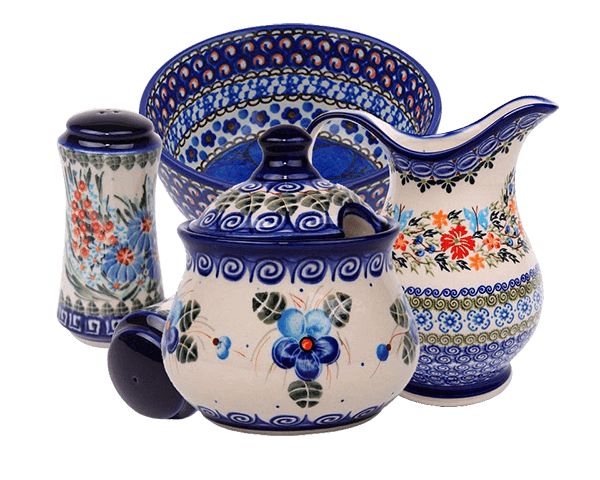
Bolesławiec stoneware is made in Poland’s Lower Silesia region, where artisans have been throwing and painting pottery for centuries. Each piece is hand-decorated using a sponge-stamp technique, producing those instantly recognisable patterns — peacock eyes, florals, geometric lines — in rich blues, greens, and terracottas. These are the sorts of colours that look extraordinary in a candlelit dining room on a cold January evening.
Beyond aesthetics, the practical qualities make this ware a genuine pleasure to use. It’s oven-safe, dishwasher-safe, and robust enough to handle the generous, hearty portions that Burns Night demands. No fussing, no worrying about chipping — just beautiful ceramics doing what they were made to do.
Setting the Table for the Address to a Haggis
Part of what makes Burns Night so theatrical is the moment the haggis is piped in and addressed with great ceremony. That presentation deserves a table that’s equally considered. Here’s how Polish pottery can help you build a scene that’s both rustic and elegant.
Soup to Begin
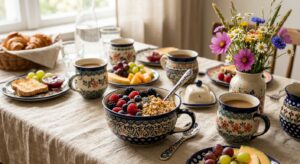
The traditional Scottish cock-a-leekie soup is a perfect opener for a Burns Night supper, and it deserves a bowl that does it justice. A deep, generously sized stoneware bowl in a midnight blue or peacock-eye pattern holds warmth beautifully and brings the right mood to the table. The thick walls of Bolesławiec pottery keep broth piping hot throughout the first course, which is exactly what you need on a January night.
The Main Event
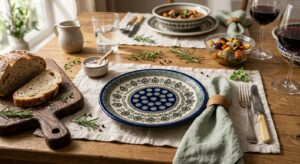
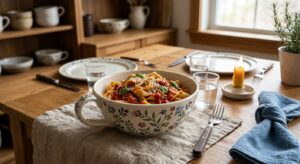
Haggis, neeps, and tatties is a meal of honest, earthy flavours and generous portions. Serve it on a broad stoneware dinner plate — the kind with a slightly raised rim that keeps everything neatly in place. The rustic character of the pottery complements the dish perfectly; there’s no clash between fine bone china and hearty peasant food here. Everything belongs together.
Consider using a large serving bowl for the mashed turnip and a separate one for the tatties. When you place them at the centre of the table for guests to help themselves, the coordinating patterns create a cohesive, considered look without feeling overly formal. That balance is exactly what the world of Bolesławiec ceramics does so well.
Cranachan for Pudding
The traditional Scottish dessert — layers of cream, oats, raspberries, and a generous splash of whisky — looks absolutely beautiful served in individual stoneware bowls. The contrast of the cream against a deep blue glaze is genuinely striking, and the rustic texture of the pottery gives the whole thing an artisanal quality that feels very much of the moment.
Things to Look For When Choosing Your Pieces
If you’re building a Burns Night table with Polish pottery, a few pointers will help you make choices you’ll be happy with long after January has passed.
- Depth matters: For soup and cranachan, choose bowls with generous depth rather than wide, shallow ones. You want plenty of room for a proper serving.
- Coordinating patterns: You don’t need an identical set — in fact, a thoughtfully mixed selection of compatible patterns often looks more interesting. Stick to a similar colour palette and the pieces will work together naturally.
- Larger plates for the main: A proper dinner plate in the 10–11 inch range gives you room to plate haggis and its accompaniments without crowding.
- A serving bowl or two: Polish pottery serving bowls are generous in size and perfect for bringing the neeps and tatties to the table family-style, which suits the communal spirit of Burns Night well.
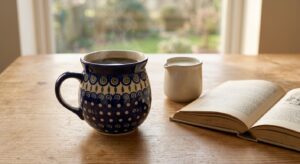
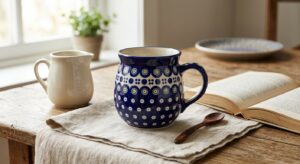
- Mugs for the Irn-Bru or the dram: If you’re serving hot toddies or finishing the evening with warm drinks, a Bolesławiec mug adds a lovely final touch.
The Atmosphere Is Everything
Burns Night is as much about mood as it is about food. The poetry, the toasts, the laughter — all of it is enhanced by a table that feels intentional. Polish pottery has a quality that’s difficult to define precisely but very easy to feel: it’s warm without being fussy, beautiful without being intimidating, and handmade in a way that people genuinely notice and comment on.
Pair your stoneware with a simple linen tablecloth in a deep green or navy, a few pillar candles, and perhaps a sprig of thistle or heather if you can find them. You don’t need much else. The pottery carries the occasion.
A Gift for a Scottish Friend
If you’re attending rather than hosting, a piece of Polish pottery makes a wonderfully thoughtful gift to bring along. A beautifully boxed mug or a pair of coordinating bowls is personal, practical, and genuinely lovely to receive. It’s the kind of gift that gets used every single day rather than relegated to the back of a cupboard.
Burns Night is ultimately a celebration of warmth — of community, of poetry, of the simple joy of a good meal. Polish pottery, with all its handmade character and honest beauty, fits that spirit perfectly. Set your table with it this January, and you might just find it becomes an annual tradition.