There’s Something About Pasta Night
Few midweek rituals beat a proper pasta supper. Whether it’s a bubbling carbonara, a rich ragu that’s been simmering since afternoon, or a simple bowl of cacio e pepe thrown together in twenty minutes, pasta has a way of feeling like a reward at the end of a long day. And yet, for all the love we pour into the sauce, we rarely give much thought to what we serve it in.
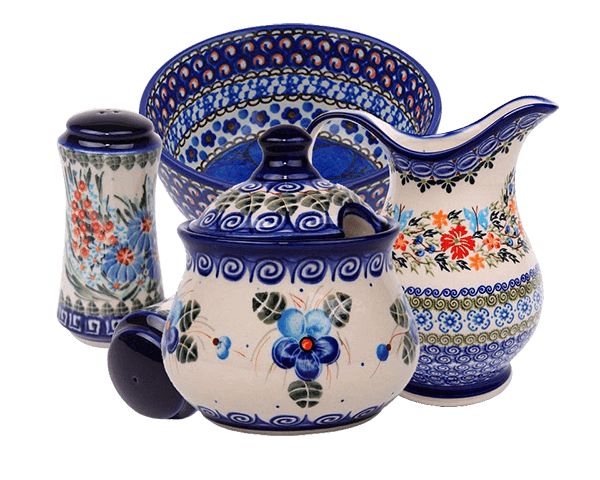
That’s where Bolesławiec pottery quietly changes everything. A deep, hand-painted stoneware bowl doesn’t just hold your pasta — it transforms the whole experience. Suddenly, Tuesday night feels a little more considered. A little more like something worth sitting down for.
Why the Bowl Matters More Than You’d Think
Pasta is a tactile dish. It’s meant to be twirled, scooped, and enjoyed with some enthusiasm. That means the vessel it arrives in plays a surprisingly important role. A bowl that’s too shallow loses the sauce. One that’s too wide lets everything cool too quickly. A mug-shaped bowl makes twirling awkward. Getting the shape right matters.
Polish stoneware, made in the workshops of Bolesławiec in Lower Silesia, has been perfecting the art of the practical bowl for centuries. The walls are thick enough to hold heat, the depth is generous without being unwieldy, and the wide rim gives you just enough room to rest your fork without losing the drama of a heaped, saucy portion in the centre. It’s form and function in the most pleasing way imaginable.
If you’ve been browsing the world of Polish ceramic tableware for a while, you’ll already know that Bolesławiec pieces tend to surprise people with how thoroughly useful they are in day-to-day life — not just pretty things saved for guests.
The Right Bowl for Every Pasta Dish
Not all pasta is created equal, and different shapes and sauces suit slightly different bowls. Here’s a rough guide to getting the pairing right:
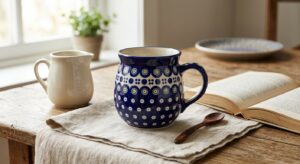
- Long pasta (spaghetti, tagliatelle, linguine): You want a deep, wide bowl with a good curve at the base — this gives you room to twirl without flicking sauce across the table. The ALMA-style loop handle bowl works wonderfully here, and the loop handle makes it easy to carry a steaming portion from the hob to the sofa without burning your hands.
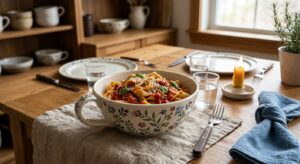
- Short pasta (rigatoni, penne, orecchiette): A medium-depth bowl with a flatter base suits chunky sauces perfectly. The pasta sits tidily, the sauce pools around it, and every forkful has exactly the right ratio of carb to sauce.
- Baked pasta (lasagne, pasta al forno): This is where Polish stoneware really earns its keep. Bolesławiec pieces are oven-safe, so you can bake individual portions straight in your bowls and carry them to the table still bubbling. It’s theatrical in the best possible way.
- Pasta salads: A wider, shallower bowl shows off a cold pasta salad beautifully. The hand-painted patterns on Bolesławiec pottery add colour that rivals even the most vibrant chopped vegetables.
A Bowl You’ll Actually Want to Use Every Day
One of the small frustrations of owning genuinely beautiful tableware is the reluctance to use it daily. We keep it for visitors, for special occasions, for when the kitchen is tidy enough to justify it. Bolesławiec pottery gently dismantles that habit.
Because it’s dishwasher-safe, microwave-safe, and robust enough to survive the everyday realities of a busy household, there’s no reason to save it. The glaze doesn’t fade. The patterns don’t chip away under normal use. You can throw it in the dishwasher after a bolognese-heavy Wednesday and it emerges looking exactly as it did the day you bought it.
This is the philosophy at the heart of Bolesławiec ceramic living — that beautiful things should be used, touched, and enjoyed rather than preserved behind glass. There’s something quietly radical about that.
Choosing a Pattern for Your Pasta Table
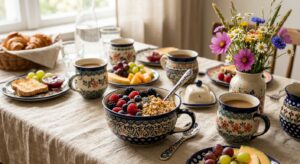
Bolesławiec pottery is instantly recognisable for its hand-stamped patterns — flowing peacock eyes, clusters of berries, geometric arrangements of dots, and botanical motifs inspired by the forests and meadows of Lower Silesia. Choosing the right one for your kitchen is part of the pleasure.
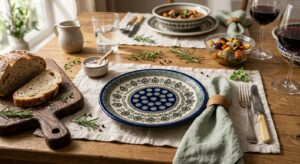
- Classic blue and white patterns suit a clean, unfussy table setting. They let the food take centre stage and look especially lovely against natural linen or a simple wooden board.
- Warmer tones — terracotta, amber, and forest green create a wonderfully rustic atmosphere that suits hearty ragu sauces and autumnal pasta dishes. Think wild mushroom tagliatelle or a slow-cooked lamb ragù.
- Bold, graphic patterns with strong contrasts make a real statement. If you like your table to have personality, these bowls do the decorating for you.
Whatever you choose, the hand-painted quality means no two pieces are identical. There’s always a tiny variation in the brushwork, a slightly different density of dots, a detail that makes your bowl unmistakably yours.
Setting the Table for a Pasta Supper
Pasta night doesn’t have to mean eating from your lap in front of the television — though there’s nothing wrong with that either. But if you do decide to sit at the table, a Bolesławiec bowl makes the whole thing feel like a proper occasion without any effort.
Pair your bowls with a simple linen napkin, a small matching plate for bread, and a ceramic mug of whatever you’re drinking. Add a candle in the middle of the table and you’ve created something genuinely lovely from ingredients that were, individually, entirely ordinary. That’s the particular magic of beautiful, everyday ceramics.
A Gift Worth Giving
If you’re looking for a gift for someone who loves cooking, a set of Bolesławiec pasta bowls is one of those ideas that feels immediately right. It’s practical without being dull, beautiful without being impractical, and personal in a way that a gift voucher never quite manages. Whether you’re buying for a housewarming, a birthday, or simply because someone you know deserves something special, a pair of hand-painted stoneware bowls wrapped up with a packet of good pasta is one of the most satisfying gifts imaginable.
The Takeaway
Pasta night is already one of life’s simple pleasures. Serve it in a handmade Bolesławiec bowl and it becomes something you genuinely look forward to — not just for the food, but for the quiet ritual of putting something beautiful on the table. That, in a nutshell, is what Polish pottery does best.