Because Pasta Night Deserves a Proper Bowl
There’s something wonderfully ritualistic about pasta night. The bubbling pot, the tangle of spaghetti, the sauce that’s been quietly simmering since you got home — it all deserves a landing spot that feels just as considered as the cooking itself. Yet most of us reach for the same tired, mismatched bowls we’ve had since university. It’s time to change that.
Polish pottery from Bolesławiec has quietly been winning over British home cooks for years, and it’s not hard to see why. These are bowls built for real life — generous in size, satisfying to hold, and dressed in hand-painted patterns that make even a weeknight spaghetti feel like something worth sitting down for properly. If you’ve been browsing the world of handmade Polish ceramics and wondering whether the hype is justified, pasta night is honestly the perfect place to start.
What Makes Polish Stoneware So Well-Suited to Pasta?
It comes down to a combination of form, function, and a little bit of beauty. Polish stoneware is fired at high temperatures, which makes it dense, chip-resistant, and brilliant at retaining heat. That matters more than you might think — pasta cools down fast, especially in a shallow or thin-walled bowl. A proper stoneware bowl holds warmth for far longer, which means you can actually savour your pappardelle rather than wolfing it down before it goes cold.
Beyond the practical, there’s the size. Bolesławiec bowls tend to be genuinely roomy. A bowl with a loop handle — one of the most popular styles — sits deep enough to accommodate a proper portion of linguine or rigatoni without everything tumbling over the sides when you twist your fork. That little handle is also a godsend when the bowl is fresh from the oven, because yes, Polish pottery is oven-safe too.
Oven to Table in One Beautiful Piece
This is where Polish stoneware really earns its place in the pasta-night kitchen. If you’re making a baked pasta — a creamy rigatoni al forno, a bubbling lasagne-style dish for one, or a leftover pasta bake that needs ten minutes under the grill — you can take your Polish pottery bowl from fridge to oven to table without a second thought. No transferring, no extra washing up, and no pretending that a foil tray looks attractive on the dinner table.
It’s the kind of versatility that makes you wonder why you ever settled for less.
Choosing the Right Bowl for Pasta
Not all bowls suit every pasta dish, so it’s worth thinking about the shape and depth you need most often.
- Deep loop-handle bowls: These are ideal for brothy pasta dishes — think spaghetti alle vongole, pasta e fagioli, or anything with a thin, soupy sauce. The depth stops splashing and the handle makes it easy to carry to the sofa when you’re watching something good on a Tuesday evening.
- Wide, shallow bowls: Better for thick, clinging sauces like a rich ragù or a creamy carbonara. More surface area means your sauce spreads evenly and the dish cools to eating temperature more quickly.
- Mid-depth bowls: The workhorse of the pasta bowl world. If you only want one style, this is the one. Versatile enough for pesto, tomato, cream, or anything in between.
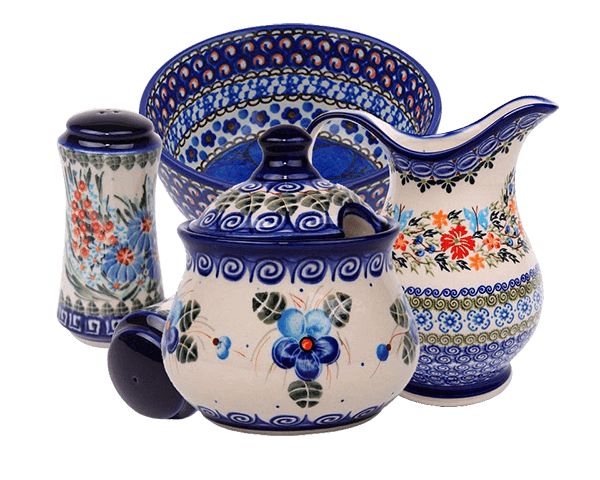
Polish pottery comes in all three profiles, with patterns ranging from the classic cobalt blue peacock eye motifs to softer florals, earthy harvest themes, and bold contemporary designs. There’s genuinely something for every kitchen aesthetic.
The Pattern Question – Which Design Works Best?
This is, of course, entirely personal — but there are a few things worth considering. Pasta dishes are often richly coloured: deep reds, earthy oranges, vivid greens from basil and pesto. A bowl with a bold, busy pattern can sometimes fight with a vibrant sauce for visual attention, which is why many people find that the classic blue-and-white Bolesławiec patterns work so beautifully. The contrast is clean, the colours complement fresh herbs and tomatoes brilliantly, and the whole table looks effortlessly put-together.
That said, if your pasta nights tend towards paler dishes — cacio e pepe, cream sauces, white fish pasta — a warmer, busier pattern can add exactly the colour and energy the plate needs.
Setting the Pasta Night Table
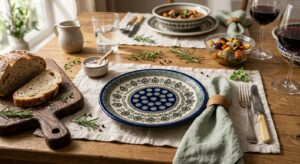
One of the quiet joys of Polish pottery is how easily it styles a table. You don’t need matching linen, candles, or a Pinterest board’s worth of planning. A few Bolesławiec bowls on a wooden table with a simple cloth and a candle stub in a wine bottle is all you need to turn Tuesday into something that feels genuinely lovely.
For pasta night specifically, consider pairing your bowls with:
- A generous bread plate — Polish pottery plates in smaller sizes are brilliant for garlic bread or focaccia on the side
- A ceramic serving bowl in the middle of the table for people to help themselves — communal eating always feels warmer when the vessels are beautiful
- Polish pottery mugs for water or wine if you’re leaning into the relaxed, mismatched look that’s so at home with casual Italian-inspired cooking
You’ll find plenty of inspiration and practical guidance over at the Polish Pottery Reviews & Recommendations blog if you’re starting to build a collection and want to know which pieces work best together.
Caring for Your Pasta Night Bowls
One of the most common questions from new owners is whether Polish pottery can go in the dishwasher. The good news: yes, it can. The glaze is durable and the stoneware itself is dense enough to handle regular machine washing without losing its colour or sheen. That said, if your bowls are particularly precious — limited edition patterns or hand-painted pieces you’ve become rather attached to — a gentle hand wash prolongs the vibrancy of the glaze over many years.
The other thing to know is that Polish stoneware can handle sudden temperature changes better than most ceramics. Moving it from a cold fridge to a warm oven is perfectly safe, which is exactly what you need on a busy pasta night when you’re reheating yesterday’s leftovers.
A Small Investment in a Better Evening
Pasta night isn’t a grand occasion — that’s rather the point of it. It’s the midweek reset, the Friday treat-yourself supper, the Sunday evening wind-down before the week begins again. It’s precisely the kind of ordinary, dependable pleasure that deserves better than a bowl you’re indifferent to.
Polish pottery from Bolesławiec doesn’t ask you to dress up dinner or pretend it’s more than it is. It simply makes the everyday feel a little more considered, a little more beautiful, and a lot more enjoyable. And for a bowl that costs less than a restaurant starter, that’s rather good value for everything it brings to the table.